


Key Takeaways
- Look for wet images before you commit. Nearly every coloured stone reads as a different product wet, and in a British winter the wet version is the one you live most of the year.
- Match the stone colour to the house. Brick, render and roof tiles do not change; borders change three times a year, so I pick against the building first.
- If using for a traffic area, lay it no deeper than roughly twice the stone size. 10mm gravel wants about 20mm depth, 20mm about 40mm. Any deeper and you wade through it rather than walk on it.
- Pale stones go algae-green in shade and the blackest chippings can show dried splashes.
- Loose coloured stone migrates into lawn and borders within a season without a physical edge to hold it.
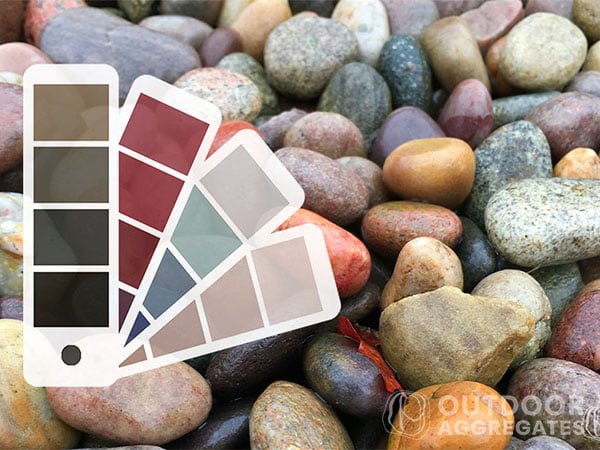
The classic version of this goes something like: a client picks a bright white or a hot pink off a photograph in June, I lay it, and by February they are asking whether it can be put back to normal. Nothing has gone wrong. The stone is just doing what stone does once it gets wet, shaded and rained on. So this is the piece I wish existed when people ask which coloured stones for garden beds and paths actually work. Colour first, then the sizes and depths that stop it going wrong, then the honest bit about when coloured gravel is the wrong call altogether.
What Colour Stones Should You Choose for a Garden?

Start with the fixed things. I hold samples against the brickwork, the path and the back door, because those colours will still be there in ten years. Then I wet them. Slate deepens dramatically, basalt goes from grey to near-black, cream flint barely shifts.
| Colour family | Works best with | Watch out for |
|---|---|---|
| Cream & buff | Red brick, cottage borders | Greens up in shade |
| Grey & silver | Render, modern builds | Flat in dull light |
| Black | White render, architectural planting | Shows dried splashes |
| Plum & red | Green foliage, dark timber | Fights red brick |
| Pink & peach | Pots, Mediterranean schemes | Dominates a big area |
| Blue & green | Water features, ferns, shade | Reads grey when dry |
| Mixed | Small beds, pathways | Muddles at a distance |

A good trick for young landscapers that nobody mentions: pick a sub-base close in colour to the stone going on top. Fresh gravel usually scuffs off and shifts in its first months, and if what shows through underneath is a similar shade, that messy early phase is nearly undetectable. The rule changes at the front of the house, where the stone is read against the brick or render rather than the border. Our front garden gravel ideas covers pale stone on dark brick and dark stone under render.
Which Coloured Stones Hold Their Colour, and Which Fade?

No stone truly fades in sunlight, but plenty look faded, and the cause is what settles on top rather than the stone itself. Limestone creams and whites under trees pick up algae and green over within two seasons. Slate holds its plum, blue or green indefinitely because the colour runs through the rock. Granite and basalt are the most stable of the lot. A material that cannot fade at all is recycled glass, because the colour is melted through the body, which is why it turns up so often on kerbed memorials where white marble would need washing every year.

The fix is usually a good wash, not a replacement. I advise clients to lift the top layer, rinse it in a barrow and put it back, rather than buying a fresh tonne. I go into full detail in the guide to cleaning garden stones.
What Size Coloured Stones Do You Need?

Gravel proper runs from 6mm to 60mm. Below that it is grit; above it cobble. For foot traffic I use 6 to 10mm, and for anything a car drives on, 10 to 20mm, because smaller stone wedges into tyre treads and travels out onto the road. The exception is a path that ends at a door, where I go up to 20mm instead: a small stone lodges in a shoe tread and comes indoors with you, and a 20mm stone is too big to sit in the groove. There is a fuller breakdown in our guide to the types of gravel for gardens.

Depth is where jobs go wrong, and there are two answers depending on who walks on it. Anywhere feet or wheels go, lay it no deeper than roughly twice the stone size, so 20mm chippings sit at about 40mm. It feels mean while you are spreading it. Go much deeper on a drive and you have built, by accident, the same thing racetracks use to stop cars. On a border nobody walks on, go the other way and lay it 50mm to 75mm, because that is the depth at which weed seed lands in the dark rather than on damp soil. Our step-by-step on laying gravel covers the build-up.
What Colour Gravel Works on a Driveway?
A coloured gravel driveway lives or dies on a mid-tone. Neutral greys, buffs and browns swallow tyre marks, oil spots and the general grime a car brings up the drive. White and black do the opposite: white goes grey in a season and shows every drip, and black shows dried splashes and dust the moment it stops raining.
Size does as much work as colour here. I use angular 10 to 20mm on anything a car sits on. Smaller stone wedges into tyre treads and walks itself out onto the road, and rounded gravel wanders instead of locking together. Depth follows the same rule as everywhere else on this page, roughly twice the stone size, so 20mm chippings at about 40mm. Go deeper on a drive and you have accidentally built the gravel trap they use to stop racing cars.
Then check it against the house. A drive is the largest single colour in most front gardens and it sits directly under the brickwork, so plum and red gravels that look wonderful against green foliage will fight red brick all day. Grey and buff are the safe pair. If the render is white or pale, a darker grey earns its place because the contrast is doing the work rather than the colour.
The one thing I would not skimp on is the edge. Loose coloured stone on a drive migrates into the lawn and out onto the pavement within a season without something physical holding it.
How Do You Stop Weeds Growing Through Coloured Stones?

Mostly you cannot, and the reason matters. Weeds in a stone bed are rarely pushing up from below; they are seeds landing on top and germinating in the dust and leaf litter that collects between the stones. A membrane buried underneath does nothing about that, which is why so many people report fabric failing after a few years.
What a good heavy duty weed membrane actually does properly is separate stone from soil so the two stop mixing. That is worth having on its own merits. Just buy it for the right reason, and see what to put under gravel first.
When Are Coloured Stones the Wrong Choice?

In my opinion, three situations.
- Under a deciduous tree, where leaves settle between stones and rot down into a seedbed.
- On a plot where planting is meant to spread, since stone offers roots nothing and holds heat against them.
- Anywhere you might change your mind, because removal is slow, brutal work.
In those spots I would go for more temporary bark or compost mulch and keep the stone for where it earns its keep: borders, pots, paths and rockeries. If you’re planning a gravel garden, colour is one of four decisions that set how much work, alongside shape, planting and whether the scheme self-seeds. All four are in low maintenance gravel garden designs.
How Much Coloured Stone Do You Need, and Where Should You Buy It?
Work out the area, apply the depth rule, and put it through our gravel calculator before ordering. The mistake I see most is small bags from a DIY shed for a bed needing the better part of a tonne. Bagged stone suits a planter or a repair, but per tonne it is the dearest way to buy, and matching a second batch later is a gamble.

Do not skip edging either. It is the cheapest part of the job and the only thing keeping the stone out of your lawn.
Next Steps
We carry the full decorative stone range in 10mm and 20mm, and if you are stuck between shades, the Pebble Picker filters the lot by colour and size. Get in touch and we will put samples together before you order.
If you would rather talk your coloured stones through with a person, ring Outdoor Aggregates on 0330 043 7585. The office is open 7am to 7pm, seven days a week.
Have you ever laid coloured stone in your garden? Which one did you go for, and has it kept its colour? Let us know in the comments.
FAQs
What coloured gravel is best for a driveway?
An angular 10-18mm in a mid tone. Neutral greys, buffs and browns hide tyre marks and drips in a way white and black do not – and they affect what a gravel driveway costs very little.
Can you mix different coloured stones together?
Yes, but vary the size as well as the colour, or it reads as a bag of sweets. Two tones and two sizes is usually plenty.