


Key Takeaways
- I use a permeable weed membrane under aggregates to stop sinking and weeds while allowing good drainage in wet weather.
- The lifespan of different weed suppression fabrics: 10–15 years for non-woven landscape fabric; 15–25+ for heavy-duty woven geotextile; plastic sheets last 5–10 years.
- Heavy-duty fabrics are a must for driveways and high-traffic areas longevity, especially under vehicle weight.
- Jump to my easy selector guide on the right type of weed membranes to use for specific applications.
- Good drainage is key to a lasting foundation. I give you the knack with my 6 pro tips on laying a membrane with sub-base.
- Avoid plastic sheets in most cases – it traps water, causes moss and poor drainage; only for non-planted areas needing total weed kill.
I’ve laid thousands of square metres of gravel across gardens, paths and driveways across the UK over the past 15 years, and the single biggest question I get asked on site is always: “What is the best thing to put under gravel?” The short answer is this: for almost every gravel project, a permeable barrier to keep the stones separated from the soil below is the best choice. Skipping any barrier altogether usually costs you more time and money later.
There are a few types: heavy duty weed membrane; landscape fabric (the lighter version); and the old plastic sheet (which is rarely the answer). In this guide I’ll walk you through exactly why, which option suits your project, and the step-by-step process I use on every install so your gravel stays put, drains properly and looks sharp for years.
At a glance – your three main options
- Landscape fabric → permeable, best all-rounder for most gardens and light traffic areas
- Heavy-duty weed membrane → tougher, woven geo-textile version for paths, driveways and traffic
- Plastic sheet (HDPE mulch film) → only for total weed kill in non-planted areas (and even then, I rarely recommend it)
Why You Usually Need Something Under Your Gravel
Picture this: You’ve picked your beautiful flamingo gravel, you’ve pictured the finished look, and then reality hits – will weeds push through next Summer? Will you end up with a muddy mess instead of the low-maintenance dream you wanted as it sinks into the soil after heavy rains?
In my opinion, gravel looks fantastic straight out of the bag, but soil has a habit of swallowing it up over time. Clay-heavy ground in the South East, or the wetter, softer soils I see in Devon and Cornwall, make the problem worse. Without a proper barrier the stones slowly mix with the earth below, weeds find their way up, and you’re forever topping up or repairing ruts.
Of course, on more deeply prepared channels with a good compacted sub-base, the weeds you’ll see much later on are usually the ones blown in by the wind. Their seeds settle into the gravel and take root in any gaps or organic matter that builds up over time. That’s exactly why I always recommend a quality membrane between the soil and your gravel layer. It breaks the connection, keeps things cleaner for longer, and saves constantly battling new growth.

From experience, putting the right layer underneath gives you four big wins:
- Stops the gravel sinking and disappearing into the soil
- Suppresses weeds from below, by blocking the roots, while still letting water through
- Keeps the surface level and stable even after heavy rain or foot traffic
- Makes future maintenance far easier – you can rake or top up without digging out mud
I learned this the hard way early on. On one of my first big path jobs in a Surrey back garden the client was old school and wanted no membrane – just compacted soil and then gravel. Eighteen months later we were back relaying the whole thing because the stones had sunk 2 cm and dandelions were coming through like they owned the joint. I’ve seen the difference on projects across the south – paths that stay sharp and low-maintenance for years versus ones that slowly sink into the soil because the barrier was skipped. These days I never skip it on a gravel surface.

Our quality, woven polypropylene heavy duty weed membrane rolls are 14m long and 1m width. Backed by a 10 year manufacturers guarantee, this 95gsm thick weed control fabric won’t tear or puncture easily, making it perfect for rough uneven ground, patios and pathways. It effectively adds stability to sub-bases while…
As a side note; it is true that for decorative borders or very low-traffic areas you can get away with just compacting the soil very well if they are really not your preference. However, for paths, driveways, patios or any area that gets regular use I always insist on a barrier as bog standard and non-negotiable.

Fabric, Membrane or Plastic? The Clear Comparison
This is the part where most DIYers get stuck, so let’s cut through the confusion with the exact fabric I use on site.
| Option | Permeability | Best for | Pros | Cons | Durability | My recommendation |
|---|---|---|---|---|---|---|
| Landscape fabric (non-woven) |
High | Light paths, borders, patios, water features, drains | Excellent drainage, easy to cut & shape, great weed control | Not recommended under traffic of any kind | 10–15 years | Go-to choice for most DIY jobs |
| Heavy-duty weed membrane (woven geotextile) |
Good | Driveways, high-traffic paths, sub-bases | Very strong, excellent separation, handles weight | Slightly less permeable than non-woven | 15–25+ years | Essential for anything with cars |
| Plastic sheet (HDPE mulch) |
None | Total weed kill in non-planted areas | Cheap, completely blocks weeds | Poor drainage, causes moss & hard to remove | 5–10 years (but problematic) | Almost never – only if no plants nearby |
In my experience the woven and non-woven fabrics are the clear winners for British conditions. Plastic might seem like a quick, cheap win for weed control, but it stops water draining away. After a few wet winters you end up with a soggy layer underneath that grows moss and makes the gravel slippery. I’ve ripped out more plastic installations than I care to remember – it’s very old school. Permeable fabrics let rainwater through so your soil stays healthy and the gravel dries out quickly after rain.
Our Fabric Guides

Also, when I prefer to mulch instead of laying weed membrane.

Ben Parrot

From installing hundreds of projects, a heavy-duty membrane is the one layer I never skip
Ben Parrot
Which Option Is Best for Your Specific Project?
Different jobs need different solutions – here’s the quick decision guide I use.
Decorative gravel gardens & borders: Standard non-woven, punched landscape fabric is perfect. It keeps the area tidy around plants and lets the maximum water reach the soil. Here is the best way to plant with weed barrier. Here is the best way to plant with weed barrier, and if the gravel is already laid, I have set out how to plant into existing gravel step by step.

Garden paths & patios: Non-woven fabric plus a compacted sub-base. If the path gets constant use, add grids for extra stability. If you are making a steppingstone path in a soft bed of gravel or bark mulch make sure you cut around each stone to make openings in the fabric. The extra time spent laying landscape fabric properly will save hours of weeding later. Where the gravel is going down as a path rather than a bed, the membrane sits above the compacted base rather than at the bottom of the dig, and the reasons why are in our guide to how to lay a gravel path. For a seating area, the layers are the same but the depths change, and I have set the whole build out in how to lay a gravel patio. For how the membrane decision fits alongside the surface, the levels and the edging, see planning a patio.
Driveways & high-traffic areas: Heavy-duty woven geotextile membrane is non-negotiable. I always pair it with MOT Type 1 or crushed concrete on any driveway I install – the difference in longevity is massive.
Cobblestones: When installing cobblestones, a base layer of heavy duty weed membrane topped with a 5cm layer of tamped gravel followed by a 5cm layer of tamped sand will improve drainage and deal with weeds effectively.


Water Features: Non-woven landscape fabric prevents debris from filtering into basins at the bottom of fountains and water features.
Swales & Streams: When constructing swales, weeds will be kept back from the edge if you line the base with non-woven landscaping fabric before filling it with rocks or pebbles and adding the water.
Dry Stream Features: If you’re building a dry stream feature landscape fabric inhibits weeds from rooting in the dry stream and spoiling the feature. Line the whole river bed with the barrier, which allows moisture through, but will prevent the growth of weeds.
Slopes or poor-draining soil: Woven geotextile membrane plus gravel grids are your best bet. The extra strength stops the gravel sliding downhill when the ground gets saturated.


Step-by-Step: How to Install Geotextile Fabric Under Gravel
Here’s the exact process I follow on every job – it’s straightforward once you know the order.
- Clear and excavate Remove turf, weeds, roots and any old debris. Dig down 10–15 cm for paths or 20–25 cm for driveways (deeper on soft ground).
- Add and compact a sub-base For anything that will take foot or vehicle traffic I lay 10–15 cm of MOT Type 1 crushed aggregate and compact it thoroughly with a plate compactor. This is the foundation that stops the whole surface sinking. Skip it on tiny decorative borders, but never on paths or drives. Find out all about them in what a sub-base is.
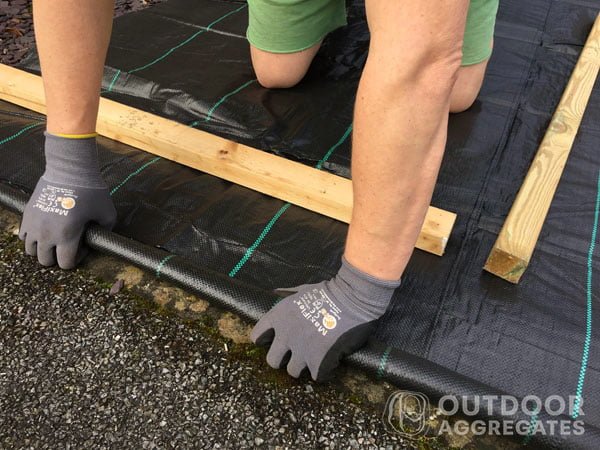
- Roll out your chosen membrane Overlap seams by at least 30 cm and secure every metre or so with landscape pegs. Cut neatly around any plants or features. On soft or clay ground, and under anything a car uses, a second sheet goes in at the bottom of the dig before the sub-base, keeping stone and soil apart. The sheet in this step is the one that keeps your gravel out of the base.
- Add stabilisation grids if needed On soft ground, slopes or busy driveways I lay gravel grids on top of the membrane. They lock the stones in place and stop them migrating.
- Spread your gravel Depth depends on what the surface is for, and there are two answers. Anywhere feet or wheels go, work to roughly twice the grade size, so about 4cm for a 20mm stone on a path or a driveway, because a deeper loose layer sinks underfoot. On a decorative border nobody walks on, go deeper at 5 to 7.5cm, which is the depth that leaves weed seed in the dark. Rake level and compact lightly, then top up and compact again. Job done!

6 Pro-Tips On Laying Weed Membrane For A Solid Sub-base
I’ve always said that building a solid base is an essential part of successful hardscaping. One of the things that many DIYers don’t realise is that a good base isn’t just hard, it’s one that drains extremely well. Here are some tips on using a membrane with your sub-base.
- Topping a sub base with heavy duty weed membrane prevents soil and gravel dust from seeping into the base and making it less able to drain.
- A membrane prevents gravel from settling into the subbase on paths and driveways, reducing sinking and maintenance issues later.
- Another way you can do it is to pack the fabric with 1 inch of a sub-base with fines, or a fine washed sand. This prevents gravel from punching holes in the membrane. Both materials compact, reducing the downward migration of surface gravel.
- On slopes, start at the laying from the bottom and work up so water runs over the overlaps rather than under them.
- Always stretch the membrane nice and tight as any wrinkles can turn into trip hazards or weak spots later.
- Edging can help hold landscape fabric in place. If you don’t use the appropriate edging, you will need landscape spikes to hold the fabric down.

Next Steps
After installing gravel features across the south of Britain, I can tell you this with complete confidence: the time you spend laying the right membrane will save you money and hours of maintenance for years to come. In most cases either a quality permeable weed membrane or non-woven landscape fabric is the winner. They give you drainage, stability and low upkeep all in one go. Your dream gravel garden or driveway is closer than you think, and with the right underlay it’ll stay looking sharp throughout the years.
Ready to crack on with your project? Check out our collection of quality aggregates and take advantage of our gravel calculator to work out exactly how much you’ll need.
If you would rather talk what goes under your gravel through with a person, ring Outdoor Aggregates on 0330 043 7585. The office is open 7am to 7pm, seven days a week.
What did you end up putting under your gravel, and has it stayed where you laid it? Let us know in the comments below.
FAQs
Can I lay gravel straight on soil?
Gravel laid straight onto soil sinks into it within a season or two, so it only suits a small decorative border. Anywhere that gets walked on wants a compacted sub-base with landscape fabric over it, and that pairing is what stops the stone sinking and the soil coming up. On a path in constant use, gravel grids over the fabric add stability.
Should I use fabric or plastic under gravel?
Fabric beats plastic under gravel every time, because a permeable sheet lets rainwater through while plastic holds the water in the ground. Trapped water grows moss and makes the gravel slippery, and I have ripped out more plastic than I care to remember. The only case for plastic is a non-planted area where you want total weed kill and accept the drainage cost.
What’s the difference between landscape fabric and weed membrane?
Landscape fabric and weed membrane are used as names for each other across the UK trade, so the label settles nothing. Buy on weight and weave instead: lighter non-woven for borders and beds, heavier woven geotextile for paths, patios and anything taking traffic. In most garden situations either will do the job.
Do I need membrane under a gravel driveway?
A gravel driveway needs a heavy-duty woven membrane, because vehicle weight drives the stones and the sub-base down into each other. Skip it and you get dirt in the drainage, ruts, and constant topping up.
Will weeds grow through landscape fabric?
Weeds rarely grow up through landscape fabric that is laid and overlapped properly, but they will seed into the gravel above it. Japanese knotweed and bamboo are the exceptions, and no fabric on the market reliably stops either. Clear existing weeds and their roots before the sheet goes down, because fabric denies light to seed in the soil rather than smothering established growth.
What is the lifespan of different weed suppression fabrics?
Non-woven landscape fabric under gravel lasts 10 to 15 years, heavy-duty woven geotextile 15 to 25 or more, and plastic sheet 5 to 10. The thinner non-woven grades tear easily, which is what usually ends them rather than age.