

south East Coast Beach Themed stones

By Ben Parrot – Landscape Gardener & Amateur Geologist
Classification:
Stone landscaping material and construction aggregate
Geological name(s):
Sedimentary rock
Other Name(s):
Grey gravel
Overview
Welcome to the only encyclopaedia for decorative aggregates and landscaping materials. Lomond gravel is an mid-priced and hard-wearing decorative aggregate known for its distinctive appearance similar to that of gravel found on Britain’s South East coast beaches.
This encyclopaedia entry provides a thorough overview of Lomond gravel, a hardscaping material and construction aggregate. It details the product’s specifications, accompanied by photographs, and outlines its benefits, applications, and incompatibilities as a landscaping material. Additionally, this entry serves as a gateway to a wealth of DIY resources, with a list of comparable alternatives, articles offering design inspiration and fundamental principles, and a collection of straightforward, step-by-step instructions for constructing your own hardscaping features.
Specifications
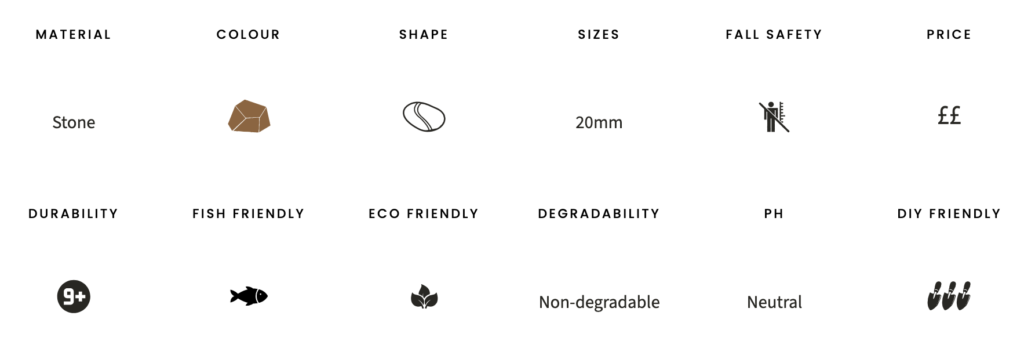
Size Range
20mm (0.8″)Lomond gravel 20mm, grey 20mm gravel, 20mm grey gravel
Fall Safety
Unsuitable for play surfaces
Price
Mid
Durability
High
Fish Friendly
Yes

Eco-friendly
Yes
Degradability
Non-degradable
pH
Neutral
DIY-Friendly
Yes

Benefits
Decorative aggregates like Lomond gravel offer numerous advantages in garden and landscape design. They are durable, low-maintenance, and provide excellent drainage, making them ideal for ground cover, paths and other outdoor applications.
Lomond gravel, with its hard-wearing quality and subtle tones, adds a natural and serene element to landscapes, complementing the look of outdoor spaces with its subtle colours and textures. Its rounded shape and smooth, natural stone materials make it comfortable underfoot when used for pathways.
- Inhibits weeds
- Improves drainage
- Hard-wearing
- Eco-friendly, sustainable
- Low-maintenance
- Moisture retention
- Versatile all-rounder
- pH neutral
- Transform space fast
- Safe for aquatic life
- Root protection
- Easy to lay
Applications
Lomond gravel is particularly suitable for creating paths and as a decorative top layer in garden beds. It can also be used for driveways, although the rounded shape of the products will lead to shifting, requiring more upkeep than angular-type gravels or chippings.
In the following section, we list many common Lomond gravel uses, although it is not exhaustive. Wherever there is a hyperlink beside an item, an article from Outdoor Aggregates about the topic is available.

Inspiration and Informational Articles
- Gravel paths in gardens
- Gravel for driveways
- Stone chippings for driveways
- Gravel for garden borders
- Edging for gravel
- Gravel mulch
- Gravel for rockery
- Patio gravel ideas
- Creative uses for leftover decorative gravel
- Ideas for small gravel gardens
DIY-Friendly How-To Guides
Need to work out how many stone chippings your project needs? Try our free gravel calculator.
Other Applications
Some other excellent applications for Lomond gravel include:
- Base for terrace, patios or outdoor seating areas

Unsuitable For
The following list represents the kinds of applications that Lomond gravel may not be suitable for:
- 1Less suitable for vehicular, high-traffic areas due to its rounded shape.
- 2Areas with fine plantings: If you have creepers or low-growing plants in your garden gravel can make it harder for these plants to thrive, as it may interfere with their root systems as they try to grow.
- 3Play surfaces
- 4Inappropriate for surfaces requiring more stability, like steep slopes.
Maintenance

Lomond gravel are generally low maintenance, especially when a heavy duty membrane is installed underneath to suppress weeds, with most work limited to raking and the occasional removal of debris. Occasional power washing of the product is advisable to maintain the original colour and prevent algae or moss buildup. Natural quarry materials also may have dust, which should be hosed off with water at the time of installation.
For areas with heavy footfall, such as paths or footpaths, replenishment of gravel may be required over time to maintain depth and coverage. For more on how to clean gravel, read our article: how to clean garden stones.
Purchasing Tips

When purchasing Lomond gravel, consider the size options and quantity necessary for your project. Where available, it is cost-effective to request a sample to assess the stone’s colour and quality against your design requirements. Also, consider the different sizes; for instance, Lomond gravel 20mm is typically used for driveways and pathways. Smaller gravels are better suited to footpaths where available.
Using our gravel calculator to get an unbiased estimate for your project needs is one of the best and easiest ways to order the right amount without the risk of shortfalls or over-spending – all you need is a few measurements of the space. Ordering in bulk bags is often more cost-effective than smaller quantities. Also, always ensure you consider the delivery aspects, especially the vehicle access to the site.
FAQs
Is 20mm gravel ok for driveway?
Yes, 20mm Lomond gravel is ok for driveways, offering good drainage and durability. However, due to the rounded shape, it is a less stable surface than angular-type gravels.
Is 10mm or 20mm gravel better for drainage?
20mm gravel is generally better for drainage as it allows more space for water to filter through.
Is 20mm gravel ok for patio?
Yes, 20mm Lomond gravel can be used for patios, providing a natural and aesthetic finish.
There are many wonderful types of gravel and aggregates available for your project needs. Check them out!