
A VERSATILE LANDSCAPING GEM

By Ben Parrot – Landscape Gardener & Amateur Geologist
Classification:
Wood decorative material and landscaping aggregate
Scientific name(s):
Pine bark
Other Name(s):
Playbark, play bark chippings, play bark chips, play area bark chips, garden play bark, play chippings, play safe bark
Overview
Welcome to the only encyclopaedia for decorative aggregates and landscaping materials. Play bark, also known as play bark chippings, is a mid-priced and compostable aggregate for play area safety surfaces that must meet strict certifications in the UK. It is a durable product usually obtained from European maritime pine trees that can last more than five years, dependent on a few factors. It usually has a dark brown to reddish colour that creates a wonderful, natural look and contrast against the plants and shrubs in your garden. This natural aggregate is best suited for play area projects where safety and appearance are important factors.
This encyclopaedia entry provides a thorough overview of play bark, a landscaping material and compostable, decorative aggregate. It details the type of product’s general specifications, accompanied by photographs, and outlines its benefits, applications, and incompatibilities as a garden material. Additionally, this entry serves as a gateway to a wealth of DIY resources, with a list of comparable alternatives, articles offering design inspiration and fundamental principles, and a collection of straightforward, step-by-step instructions for constructing your own garden features.
Important note: As this is a general page about play bark, it is essential to note that variability factors may exist, not just between brands but also between products from the same supplier. If a product’s appearance or any other aspect is important to you, we advise requesting a sample of the current stock, prior to ordering.
Specifications
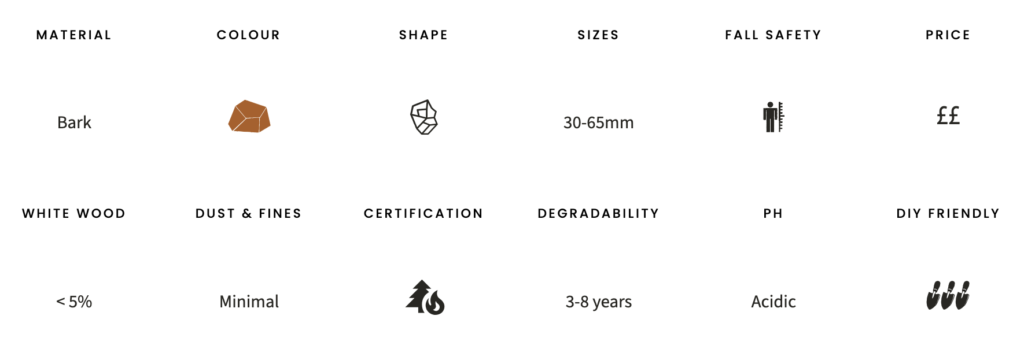
Size Range
30-65mm (1.2-2.5″)
Fall Safety
Suitable for play surfaces at depth
1.6m @ 100mm, 4m @ 200mm, 5m @ 300mm
Price
Mid-priced
White Wood Content
Less than 5% on average
Dust and Fines Content
Minimal

Fire Safety
Yes
Degradability
3-6 years
pH
Slightly acidic
DIY-Friendly
Yes

Benefits
Using decorative aggregates like play bark for garden projects offers many benefits. They are aesthetically pleasing, help retain soil moisture, suppress weeds, and provide a natural, rustic look. Plus, they are relatively low-maintenance, making them a practical choice for busy homeowners and public spaces alike.
Play bark is particularly beneficial for play areas. It’s a natural, attractive option possessing cushioning properties that make it ideal for play areas, by reducing the risk of injuries. Additionally, with its nuggety-shape allowing for rapid drainage during wet weather, it makes safe play possible all year round, while reducing muddy footprints indoors.
Considering its pH level, play bark is slightly acidic, which can be beneficial for certain plants that prefer such conditions. However, it might not be suitable for alkaline-loving species. Careful consideration of the surrounding flora is advisable when introducing play bark into your garden, outside of a play area.
- Inhibits weeds
- Fast drainage
- Durable
- Eco-friendly, sustainable
- Low-maintenance
- Moisture retention
- Versatile all-rounder
- pH acidic
- Transform spaces fast
- Fire safety compliant
- Root protection
- Easy to lay
Certifications
This section lists the types of certifications that are available for this type of product and what they are for. However, this is a guide about the generic type of product, play bark. There may be many brands sold under this product category, but that does not guarantee their individual compliance, and it may not always be necessary depending on individual preference.
For example, BS 7188 does not provide fall safety certification without the complimentary BS EN 1177 certification, yet some suppliers advertise it as fall safety certification when it is not.
This guide equips you with an understanding of certifications to consider, depending on their relevance to your specific use case, or whether they are deemed essential for your individual project outcomes. We add advisory for particular use cases, where we consider the certification to be critical for that type of application or situation. Any products listed on our site will always show their compliance, where it is applicable.
*BS 7188 is an optional supplement to BS EN 1177, offering further testing procedures and criteria for resistance to abrasive wear-and-tear, slip resistance, resistance to indentation, and flammability.
Certification | TYpe | applications | recommended |
|---|---|---|---|
BS EN 1177 | Fall Safety | Play Areas | Yes |
BS EN 4790 | 1987 Fire Tested | Fire prone areas | Yes |
BS 7188* | Product resistance | Play areas | Optional |
Sustainable Forestry | Sustainability | Optional |
Applications
Play bark products are predominantly used in children’s play areas for their certifiable shock-absorbing qualities. Although generally more expensive other decorative bark, it can also be used in landscaping to create borders, rustic pathways and mulched flower beds. It adds a unique texture and brings a natural, organic feel to any space it occupies.
Safety Warning
It should be pointed out that while manufacturing and screening, some larger pieces of wood, known as ‘wood shards’, may fall through the screens and end up in the final product. If these wood shards are deemed hazardous, they should be removed after installation. This can be done manually by hand in accordance with best practices.
In the following section, we list many possible uses for play bark in landscaping. Wherever there is a hyperlink beside an item, an article from Outdoor Aggregates about the topic is available.

Inspiration and Informational Articles
- Wood chip for play areas
- Wood chip path
- Wood chip driveway
- Ground cover and decorative borders
- Wood chips for chickens
- Bark mulch 101: The basics about different bark products
- Natural bark for play areas
- The pros and cons of using bark mulch for gardens
- Planters and pot plants
- Terrariums and indoor plant decor
DIY-Friendly How-To Guides
- Building a natural childrens play area
- How to lay bark chippings
- How to lay a wood chippings path
- Installing a wood chips driveway
Need to work out how much bark your play area project needs? Try our free play bark calculator.
Unsuitable For
The following list represents the kinds of applications that certified play bark may not be suitable for:
- 1Areas prone to water-logging or flooding. Rubber play bark or pea gravel may be more suitable.
- 2Plantings that like highly alkaline garden soil.
- 3High-traffic walkways.

Fall Safety Comparison
For your information, we provide the critical fall height safety of comparable materials.
Material* | Depth 15cm/6″ | Depth 23cm/9″ | Depth 30cm/12″ |
|---|---|---|---|
Wood chips | 2m/7′ | 3m/10′ | 3.3m/11′ |
Play bark | 1.8m/6′ | 3m/10′ | 3.3m/11′ |
Engineered wood fibre | 1.8m/6′ | 2m/7′ | 3.6m/12′ |
Fine sand | 1.5m/5′ | 1.5m/5′ | 2.7m/9′ |
Coarse sand | 1.5m/5′ | 1.5m/5′ | 1.8m/6′ |
Pea gravel | 1.8m/6′ | 2m/7′ | 3m/10′ |
Medium gravel | 1.5m/5′ | 1.5m/5′ | 1.8m/6′ |
Taken from page 5 of ‘The Handbook For Playground Safety’.
*For the uncompressed depth of each material.
Maintenance

Play bark is generally low-maintenance, especially when a heavy duty weed membrane is installed underneath to suppress weeds, with most work limited to raking and the occasional removal of debris. It is recommended to occasionally hose or power wash the product in order to prevent the buildup of dust and grime.
Play bark generally settles lower over time, up to 10-15%, so infrequent replenishment of the bark chippings will be necessary to maintain safety depth and coverage.
Purchasing Tips

When purchasing play bark, consider product safety certification and future replenishments when calculating the type and quantity optimal for your project. If it is a priority, request a copy of the product’s compliance certificate before purchasing play grade bark. Also, where available, it is cost-effective to request a sample to assess the chippings’ quality against your design requirements.
Our play bark calculator will give you a quick and unbiased estimate for your project needs just by taking a few measurements of the space. It is one of the best and easiest ways to order the right amount and helps avoid shortfalls or over-spending. Purchasing a bulk bag of play bark or ordering in loose loads can offer better value than purchasing in smaller quantities. Therefore, calculating accurately can save both time and money. It is also important to consider the delivery aspects, including vehicle access to the site. Additionally, you can use our site to check stock availability and factor in VAT and transportation costs if applicable. (Feature coming soon)
FAQs
How do you compare play bark vs normal bark?
Play bark is specifically engineered for fall protection and is generally softer and more uniform than regular bark, which is more decorative and varied in shape and size. We cover it in our article, bark mulch 101.
How much play bark do I need?
The required quantity depends on the area’s size and the desired depth, typically 100-300mm (4-12 inches). Our play bark calculator can provide a more accurate estimate.
How often should I clean play bark?
It should be inspected and cleaned regularly, at least every few months, to remove debris and maintain its appearance and safety depth.
What cleaning methods are recommended for play bark?
Raking to level the surface and remove debris. Occasional washing with water helps to reduce dust and dirt accumulation.
There are many wonderful types of wood chippings available for your project needs. Check them out!